

Talk to one of our sod specialists. Call: 480-456-1199

Proud Partner of the
Arizona Cardinals


Summer is the time to get your lawn back into shape! Warm season grasses love the heat and the humidity. This is your opportunity to get your sod grass lawn in the best possible shape. There are a few essential procedures that can help any yard – fertilization, dethatching, and an irrigation check-up. Click the links below to jump down the page.
One of the main causes of lawns looking "old and tired", or thinning out, is thatch build-up. Thatch accumulates during the winter if you over-seed your lawn. If you don't over-seed, thatch accumulates during the summer, but is made worse during the winter when the summer lawn goes dormant and the old leaves begin to die. After a number of years of thatch accumulation, the thatch begins to form a layer that repels water and does not allow the soil to "breath". Lawns with excessive thatch will begin to have large areas that look thin, wispy, and eventually brown. These areas will also repel water, or allow water to puddle for an extended period of time. Stick a screwdriver in the ground and see how far it goes in the ground before it hits dirt. If your thatch is more than an inch in depth you are beginning to have a serious thatch problem. When these symptoms begin to appear it is time to dethatch!
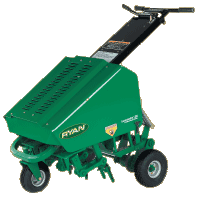
Old lawns with extreme thatch, or lawns with heavy traffic are good candidates for aerification. Aerification is normally performed with a machine that pulls small "cores" out of the lawn, about ½" in diameter. These holes will allow oxygen into the root zone, improve water penetration, and will relieve the lawn of compaction. This is a service that can be by a contractor, or you can rent an aerator from a local equipment rental company and do it yourself. Please note that aerification is not a replacement for dethatching.
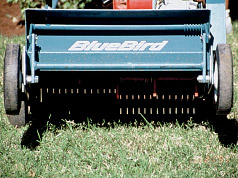 This
is the easiest method to remove excessive thatch from a sod grass lawn. There may be a lot of material
to haul-off, but with the right machine it is not a difficult job. Power rakes,
dethatching machines, or verticutters as they are sometimes called, have a
series of "knives" that dig lightly into the lawn and pull-up old
leaves and debris. Run the verticutter over the lawn, then rake and remove
the debris. When you are done dethatching, fertilize with a full rate of fertilizer
(1 pound of actual nitrogen per 1,000sf) to aid the turf with recovering quickly
from the process. Verticutting machines can be rented at a local equipment
store.
This
is the easiest method to remove excessive thatch from a sod grass lawn. There may be a lot of material
to haul-off, but with the right machine it is not a difficult job. Power rakes,
dethatching machines, or verticutters as they are sometimes called, have a
series of "knives" that dig lightly into the lawn and pull-up old
leaves and debris. Run the verticutter over the lawn, then rake and remove
the debris. When you are done dethatching, fertilize with a full rate of fertilizer
(1 pound of actual nitrogen per 1,000sf) to aid the turf with recovering quickly
from the process. Verticutting machines can be rented at a local equipment
store.
99% of the problems found on sod grass lawns in Arizona are associated with water, too much or too little. Because most irrigation clocks are set to run at night or early in the morning, most people never actually see their sprinklers in action. Many times heads can become plugged with debris, parts wear-out, nozzles get turned the wrong direction, and the list goes on and on…
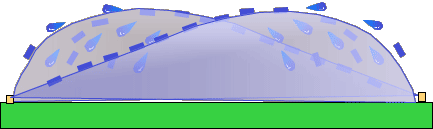
Turn your system on and watch it run. Any areas that usually turn bluish gray demand your attention first. Make sure that you have 3 heads hitting each area of the yard (they call this triangular spacing). Any area that only has two heads covering it will most likely start showing signs of stress first. Adjust your sprinklers to get the proper coverage. Also make sure that the sprinklers get "head-to-head" coverage.
Established sod lawns will require water 2-3 times per weeks, applying the equivalent of three quarters of an inch to half-inch of water per watering cycle. New lawns (installed within the last 4-8 weeks) may still require nightly watering. For more detailed information on watering you may also visit the Arizona Meteorological website.
A healthy sod lawn begins with healthy soil. Your lawn requires a good source of nutrients to maintain its color and vigorous growth. Be careful not to over-fertilize, as this can cause excess growth, excess thatch build-up, and excess work for YOU! Too little fertilizer can leave your lawn thin, yellow, and slow to recover from wear. To keep it looking its best, your lawn requires a balanced diet, with the right amount of food on a consistent schedule—just like people do!
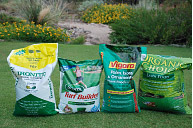 Lawns should be fertilized monthly with a complete fertilizer using an analysis similar to a 29-2-4 with iron, or 28-0-4 with iron. Feed the lawn monthly until the sod is thick and dense.
A lawn that is thick, dense, and dark green may only require fertilizing every 6-8 weeks, therefore a slow-release fertilizer is recommended. Slow release fertilizers slowly spoon feed the nutrients over time, allowing for a small constant feeding to the root system. This will allow for continued dark green color with slower growth. Slower growth means less thatch and less mowing!
Palmetto St. Augustine is a unique variety of sod grass, adaptable to partial shade, but also grows in full sun. One of the benefits of Palmetto is that it does not require a lot of nitrogen. Palmetto should be fed with a fertilizer high in potassium and magnesium. Many palm tree fertilizers are suited well for Palmetto. They have a high amount of potassium and a micronutrient package that will green-up the lawn, but not cause excessive growth. Palmetto can be susceptible to some diseases if it is allowed to build-up excessive thatch. Feed Palmetto at a half rate of what is recommended for most grass varieties.
Celebration is one of the darkest green warm season Arizona sod varieties. Because of it's genetic color it does not require a lot of fertilizer to keep it green. For the best success with Celebration it is recommended that you mow Celebration low (3/4 of an inch) during the month of April, removing the old leaves that have gone dormant during the winter. Fertilize the lawn with a balanced fertilizer, 8-8-8 or 15-15-15 containing micronutrients. This will give the lawn a jump start on summer with new, dark green leaves.
Once the lawn has reached full density, fertilize at a half rate monthly with a soluble fertilizer like ammonium sulfate, or a full rate of a slow release fertilizer (29-2-4) every 6-8 weeks. This will keep the lawn dark green, but will not force it to grow excessively. Once Celebration has reached full density, you can reduce watering to only 1-2 times per week (water deeply) giving you a dark green, drought resistant yard, that will require mowing only once every 7-10 days.
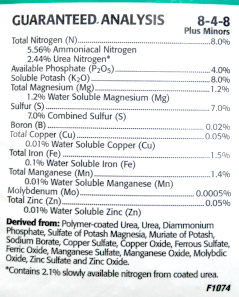 Confused
by fertilizer labels?
Confused
by fertilizer labels?Learn about the role of fertilizer in this downloadable PDF.